
Hyundai and Kia’s self leveling shock…understanding how it works
When we made our very first Telluride/Palisade 2″ lift kit we used an EX model – it was brand new to the dealer, the first one they got and we talked them into letting us lift it…it did NOT have the self leveling shock, the dealer didn’t even know what that was.
Needless to say, when we did the second Telluride for them ( first one sold in under 24 hours) it had the self leveling shock and we had some work to do…no problem, we were very familiar with the shock, it has been used before on other SUV’s in the past.
Take a read and understand what makes this shock so special and why Hyundai and Kia are using it on their SUV’s…it helps to make for a smooth ride when you are loaded or unloaded, the shock compensates for load and weight.
Here we go, read on and learn….Hyundai and Kia SELF LEVELLING SHOCKS – critical information!
The NIVOMAT shock works on hydraulic pressure from MOVEMENT and load…so as you drive, as you load your vehicle, the rear ride height will adjust.
How the system works…a technical breakdown:
What gives the shock its leveling capability is a pump mechanism and oil reservoir that can increase the accumulator pressure, which increases the shocks lifting capability. It is used in combination with springs matched to the load capacity of the shock to reduce suspension travel while utilizing more of the piston and shaft travel of the shock.
This maintains the ride quality whether the vehicle is operated with a driver only or to compensate for passengers and luggage. The big advantage to the Nivomat is the shock absorber requires no plumbing, compressor and height sensing device to level the vehicle. The normal movement of the suspension over a regular road surface provides enough pumping action to level the vehicle.
Leveling Components:
The accumulator can be a diaphragm or piston. The normal pressure contained the accumulator ranges from 20 bar (290 psi) to 50 bar (725 psi). The pump can increase the accumulator pressure from 90 bar (1305 psi to 130 bar (1885 psi). Under driving conditions, pressure can reach 350 bar (4,424 psi).
The control sleeve is fixed in the shaft and controls oil flow through the spiral cut and release bore in the pump rod. The inlet valve is a one way check valve located at the end of the spiral cut in the hollow pump rod.
The low pressure oil reservoir contains the oil used to charge the pump mechanism. The pump is located at the end of the control sleeve and uses a pump cup, pump and balance spring.
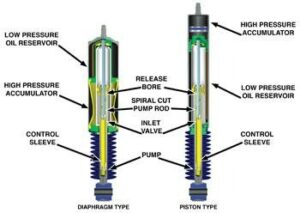
Leveling Operation:
The Nivomat shaft and piston provide the same damping as a normal monotube shock. The difference is that the shaft is hollow and contains the pump mechanism. The pump is operated by the displacement of oil caused by the movement of the shaft in and out of the shock. When the piston shaft moves out of the shock, oil is drawn from the low pressure oil reservoir through the hollow pump rod and inlet valve into the pump chamber.
Since Nivomat is mechanical, the vehicle needs to be moving before the pump starts to work and it takes about a mile to a mile-and-a-half of travel before the vehicle reaches its optimal level point.
The pump is made up of a pump cup and balance spring. When the piston shaft moves into the shock, the oil is compressed collapsing the pump spring and expanding the balance spring to fill the pump cup. When the shaft moves out of the shock, the control sleeve opens the spiral cut in the pump rod, and the oil is forced into the main chamber of the shock. The pump and balance spring return the pump cup to its level position. This increases the pressure in the accumulator creating more lift to return the piston and shaft to the level position. In the level position, the control sleeve closes the spiral cut and the shock operates normally until the next inlet and pump action.
The release bore is used to return the shock to the level position when the load is removed from the vehicle. When the shaft and control sleeve is extended out of the shock past the release bore, the oil that was pumped to increase the accumulator pressure and lift is returned to the low pressure reservoir.
Ok, so if you are at all confused, that is fine…I took my first shock apart over 40 years ago when I first started racing Motocross, I was trying to make my suspension work as a 13 year old and I had no money…but my dad had a killer set of tools and I had no fear….whatever I messed up, I was positive my dad could save me from myself…
The shock is working like an overload spring or an airbag would under load…that is the easiest way I think to describe it…there are some things to remember when you are working with a self levelling shock…
Movement and Load are keys to how the Hyundai and Kia self leveling shock works – any restriction or added friction to movement will affect how the shock works – always remember to follow these important things….
***If you do not take care when doing the install, making sure to torque all the suspension items you loosened or removed you may cause excess friction – also be aware that you need to PROPERLY adjust the sway bars – make sure to loosen the mounts and rotate to a new balanced “happy” position.
You cannot cheat on installs, it is not hard, take your time and make sure to loosen everything, then readjust and tighten to torque when the SUV is on the ground…you need the weight of the vehicle on the suspension to properly torque it.
The most misunderstood thing with all new SUV’s is the need to ‘adjust” the sway bars (making sure to break the bar free from the frame mounts) do NOT JUST ADJUST THE ENDS, you MUST adjust the bars ***